K₂O₁₅Si₆V
alkali silicate glass · structural translucent glassK2O15Si6V1 is a alkali silicate glass suitable as structural translucent glass. Color: grey-blue. Fired at 1150°C from 4 precursors (SiO2, K2CO3, V2O5). Workshop batch: 400g at €8.77. Compressive strength ~500 MPa; estimated 0.84 kg CO₂/kg (-2% vs float glass). Notable: visible absorber. Confidence: high.
- forms at
- 1150 °C · high-fire
- replaces
- float glass
- CO₂
- 1.9% lower than float glass (0.84 vs 0.86 kg CO₂/kg)
- energy
- 62.5% lower than float glass (5.62 vs 15.00 MJ/kg)
- compressive
- 500 MPa
- density
- 2.71 g/cm³
- crystal
- triclinic
- band gap
- 2.10 eV
- cost
- €21.92/kg · €8.77 / 400 g batch
- confidence
- high (synthesis route)
- potential
- 0.80 · env 0.78 · novel 0.46 · struct 1.00 · lineage 1.00 · supply 1.00
- flags
- visible absorber: A real-colour solar-gain control layer. Where the body takes visible light into itself rather than reflecting it, the material becomes a selective heat collector — useful on thermal-mass walls, absorber panels, and warm-toned cladding.
Architectural potential
A potassium-silicate glass with vanadium colouration, reaching 500 MPa of compression and carrying both the structural and the translucent arguments at once. At 1150 °C it melts and anneals cleanly, and the 400 g batch with a 5 kg workshop ceiling gives enough reach for repeated column and tread runs. Natural placements are load-bearing pressed-glass elements where the vanadium colouration is an architectural asset rather than a defect: grey-blue stair treads in residential interiors, partition beams in gallery spaces, pressed glass piers in bath-house or spa architecture, and floor panels walked on from above in small atrium installations. The visible-absorber chemistry of the vanadium content doubles the piece as a passive solar-gain surface — on south-facing glazing, the slab takes visible light into itself rather than reflecting it, warming up as it filters. Against float glass the embodied CO₂ is essentially neutral, energy two-thirds lower, so the specification carries no environmental penalty. The caveat is annealing — at 51 mm depth the slab must come out of the kiln slowly to avoid internal stress, and edge conditioning is part of the tectonic. Saw-cut or kerf-polished edges are not interchangeable with fire-polished ones.
Material character
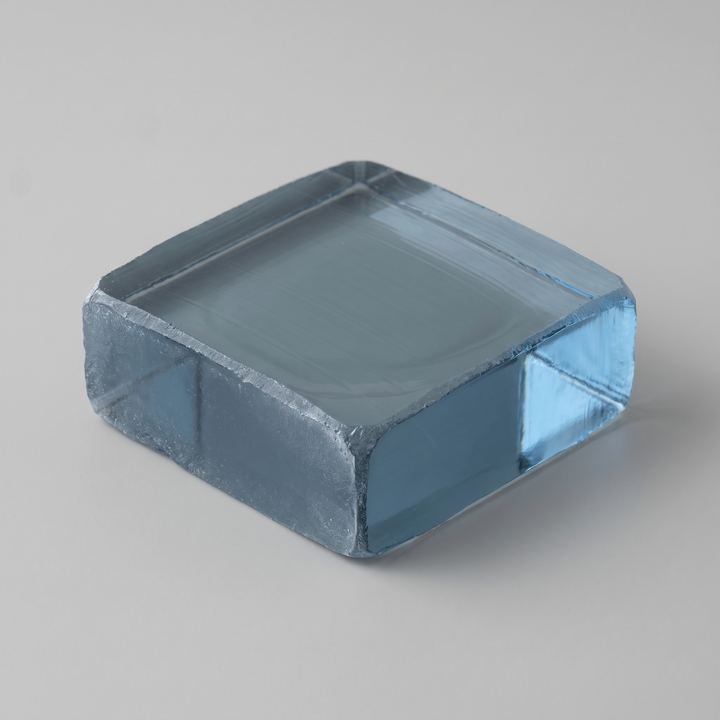
The slab carries a deep, even grey-blue from the vanadium-silicate absorption edge, distinct from the cooler cobalt-blues of the ceramic palette — steadier, more mineral, with a graphite undertone along the long sight line. At 2.71 g/cm³ in an 85×85×51 mm piece, the body sits in the familiar heavy-glass register, firm two-handed. Translucent rather than clear: the 51 mm depth reads almost opaque head-on, but a strong light behind the slab passes through with a saturated blue cast. Surface carries pressed-glass sheen with faint anneal striae on one long face; cold-cut edges show the lapidary bloom, edge-polish is optional tectonic.
Recipe
400 g batch · peak 1150 °C| element | precursor | formula | mass | safety |
|---|---|---|---|---|
| K | potassium carbonate / potash | K2CO3 | 23.44 g | safe |
| Si | quartz flour / silica | SiO2 | 61.14 g | safe |
| V | vanadium pentoxide | V2O5 | 15.42 g | moderate |
- 1Ramp
- 2Hold
- 3Ramp
- 4Hold
- 5Ramp
- 6Hold
Visible absorber — saturated color from bandgap in the visible range