Na₄O₂₂Si₈W₂
alkali silicate glass · structural translucent glassNa4O22Si8W2 is a alkali silicate glass suitable as structural translucent glass. Color: clear. Fired at 1150°C from 4 precursors (SiO2, WO3, Na2CO3). Workshop batch: 400g at €72.38. Compressive strength ~500 MPa; estimated 0.84 kg CO₂/kg (-2% vs float glass). Notable: electrochromic tungstate. Confidence: high.
- forms at
- 1150 °C · high-fire
- replaces
- float glass
- CO₂
- 1.9% lower than float glass (0.84 vs 0.86 kg CO₂/kg)
- energy
- 62.5% lower than float glass (5.62 vs 15.00 MJ/kg)
- compressive
- 500 MPa
- density
- 3.61 g/cm³
- crystal
- monoclinic
- band gap
- 3.30 eV
- cost
- €180.95/kg · €72.38 / 400 g batch
- confidence
- high (synthesis route)
- potential
- 0.81 · env 0.78 · novel 1.00 · struct 1.00 · lineage 0.70 · supply 0.50
- flags
- electrochromic tungstate: A voltage-switchable optical chemistry. In thin-film form a small DC signal shifts transmission from clear to tinted blue, opening the door to dimmable glazing and responsive partitions that do not need mechanical shading.
Architectural potential
A tungstate-doped alkali-silicate glass with electrochromic behaviour: a small DC signal shifts transmission from clear to tinted blue, opening dimmable glazing and responsive partitions without mechanical shading. Five hundred megapascals of compression and a fully transparent body at 3.61 g/cm³ lift this into the load-bearing-glass register, so the element carries structure and daylight in one piece while also carrying a switching behaviour. Natural placements are transparent partitions in office meeting-rooms that tint on command, light-admitting stair treads with switchable privacy zones in mixed-use buildings, south-facing glazed piers in gallery architecture that dim under afternoon sun, and conference-room façade panels where solar gain and visual privacy both need passive-to-responsive control. Against float glass the embodied CO₂ is only two per cent higher while the firing energy drops sixty-two per cent, so the carbon argument is essentially neutral and the energy argument is clean. The supply-chain score sits at 1.0 and confidence is high, so specification is unusually robust for a switching glass. The caveat is cost: at 72 euros per 400 g workshop batch this is a signature glazing element rather than a bulk façade material, and the electrochromic drive wiring adds a real control-integration layer to the tectonic.
Material character
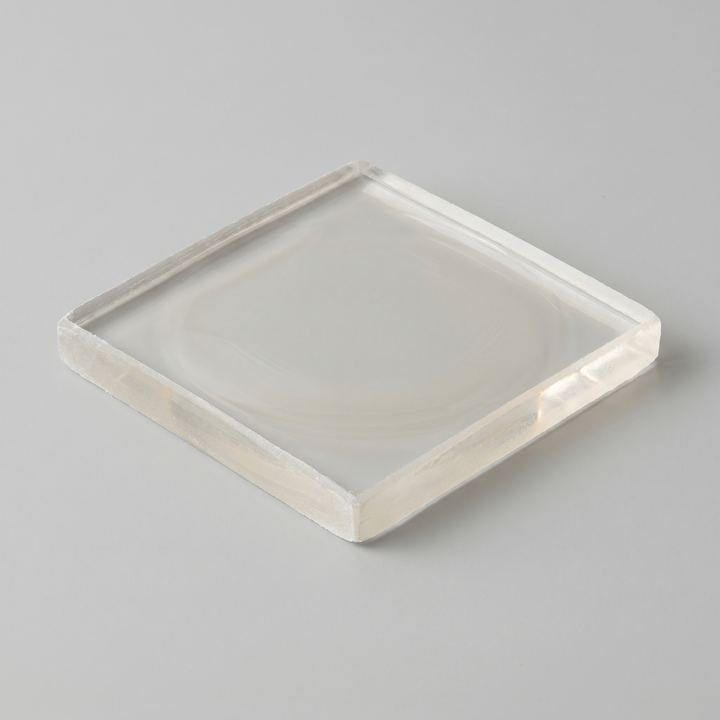
A clear alkali-silicate glass at 3.61 g/cm³ in an 85×85×38 mm slab — noticeably denser than standard soda-lime float glass of the same dimensions, so the slab sits with an unexpected heft when lifted. The body reads fully transparent at rest, with the tungstate trace giving a faint warm undertone in thick section. Surface carries pressed-glass register: a low convex crown from the annealing cycle, two thin anneal striae near the long edges, and cold-cut sides with lapidary bloom. Switched, the body shifts to a uniform dusty blue tint without losing geometric clarity. Against a simple soda-lime sibling the weight step and the switching chromism together separate this decisively from architectural float glass.
Recipe
400 g batch · peak 1150 °C| element | precursor | formula | mass | safety |
|---|---|---|---|---|
| Na | sodium carbonate / soda ash | Na2CO3 | 18.33 g | safe |
| Si | quartz flour / silica | SiO2 | 41.57 g | safe |
| W | tungsten trioxide (yellow) | WO3 | 40.1 g | moderate |
- 1Ramp
- 2Hold
- 3Ramp
- 4Hold
- 5Ramp
- 6Hold
Electrochromic — color switches under applied voltage (thin-film chemistry)