Mn₂Na₄O₂₀Si₈
alkali silicate glass · structural translucent glassMn2Na4O20Si8 is a alkali silicate glass suitable as structural translucent glass. Color: purple-brown. Fired at 1150°C from 4 precursors (SiO2, Na2CO3, MnO2). Workshop batch: 400g at €2.93. Compressive strength ~500 MPa; estimated 0.84 kg CO₂/kg (-2% vs float glass). Notable: no special functions flagged. Confidence: high.
- forms at
- 1150 °C · high-fire
- replaces
- float glass
- CO₂
- 1.9% lower than float glass (0.84 vs 0.86 kg CO₂/kg)
- energy
- 62.5% lower than float glass (5.62 vs 15.00 MJ/kg)
- compressive
- 500 MPa
- density
- 2.65 g/cm³
- crystal
- triclinic
- band gap
- inf eV
- cost
- €7.33/kg · €2.93 / 400 g batch
- confidence
- high (synthesis route)
- potential
- 0.68 · env 0.78 · novel 0.00 · struct 1.00 · lineage 1.00 · supply 1.00
Architectural potential
A manganese-doped soda-silicate glass whose architectural use departs from its clear sibling: the Mn²⁺/Mn³⁺ loading drives the body into a saturated purple-brown, so the load-bearing register here is about coloured mass rather than clarity. At 500 MPa and 2.66 g/cm³ it remains structurally serious, but the architectural argument shifts to daylighting pieces where the colour is the point — cast glass panels in memorial architecture, coloured pressed-glass stair treads under top-down daylight, partition infills for ritual and threshold spaces, pier-like light-admitting columns in chapel and crematorium interiors, and deep-colour balustrade plates. The manganese opacifies the body enough that transmission is selective rather than transparent: the piece carries light as coloured glow rather than transmitting scenes through it. Against float glass the CO₂ penalty is essentially zero (minus two per cent) and the energy cost is sixty-two per cent lower, so the environmental trade reads as a colour gain at no CO₂ cost. Natural additional placements are cast-glass hardware — newel caps, thick inlay blocks in timber balustrades — where the purple-brown reads as a pigmented mass. The caveat is colour consistency: manganese is notoriously batch-sensitive, so run-to-run variation in tone must be accepted as part of the tectonic.
Material character
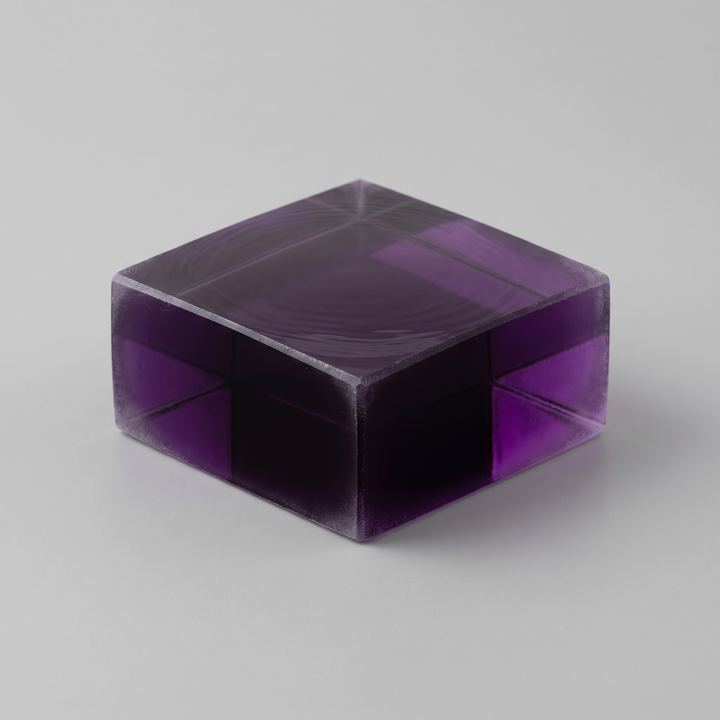
The 85×85×52 mm slab reads a saturated purple-brown, denser in colour along the long edge where the 52 mm section deepens the body into near-black. At 2.66 g/cm³ the piece is slightly heavier than its clear potassium cousin, firm one-handed but with a distinct weight step above typical soda-lime. Pressed-glass top face carries a low crown with fine anneal striae visible under raking light; cold-cut edges bloom pale against the dark body. Tap response rings clean and high, a characteristically glassy acoustic. Against conventional cobalt-blue architectural cast glass the Mn body reads warmer and more earthen — closer to amethyst than to a decorative cobalt tile.
Recipe
400 g batch · peak 1150 °C| element | precursor | formula | mass | safety |
|---|---|---|---|---|
| Mn | manganese dioxide | MnO2 | 20.07 g | moderate |
| Na | sodium carbonate / soda ash | Na2CO3 | 24.46 g | safe |
| Si | quartz flour / silica | SiO2 | 55.47 g | safe |
- 1Ramp
- 2Hold
- 3Ramp
- 4Hold
- 5Ramp
- 6Hold