K₂O₇Si₂Sn₂
alkali silicate glass · structural translucent glassK2O7Si2Sn2 is a alkali silicate glass suitable as structural translucent glass. Color: clear. Fired at 1150°C from 4 precursors (SnO2, K2CO3, SiO2). Workshop batch: 400g at €9.10. Compressive strength ~500 MPa; estimated 0.84 kg CO₂/kg (-2% vs float glass). Notable: no special functions flagged. Confidence: high.
- forms at
- 1150 °C · high-fire
- replaces
- float glass
- CO₂
- 1.9% lower than float glass (0.84 vs 0.86 kg CO₂/kg)
- energy
- 62.5% lower than float glass (5.62 vs 15.00 MJ/kg)
- compressive
- 500 MPa
- density
- 3.76 g/cm³
- crystal
- trigonal
- band gap
- 2.68 eV
- cost
- €22.75/kg · €9.10 / 400 g batch
- confidence
- high (synthesis route)
- potential
- 0.64 · env 0.78 · novel 0.00 · struct 1.00 · lineage 0.70 · supply 1.00
Architectural potential
A tin-heavy potassium-silicate glass with a clear body at 500 MPa of compression and an unusually high 3.764 g/cm³ density for a soda-lime-family material — the tin content lifts the refractive index and the weight register toward lead-crystal territory without the lead itself. Natural placements are walked-on floor panels where refractive sparkle is part of the spatial argument, stair treads in civic and cultural interiors, pressed-glass column inserts in atrium architecture, transparent light-admitting pier elements in exhibition spaces. Against float glass the CO₂ balance is nearly neutral (-1.9%) but the energy reduction in the melt is sixty-two per cent, and the tin-potassium chemistry produces a body that behaves more like optical crystal in daylight: higher internal reflection, stronger edge-glow, a more emphatic coloration of the long-edge sighting. The potassium flux aids melt homogeneity at 1150 °C, and the 2.68 eV bandgap sits the body firmly in the transparent-to-visible register. Workshop batch reaches 5 kg and supply-chain score is 1.0. The caveat is cost: €9.10 per 400 g batch is an order of magnitude above standard soda-lime production, and the tin content shifts annealing schedules away from ordinary float practice — edge conditioning must be verified against the modified stress profile.
Material character
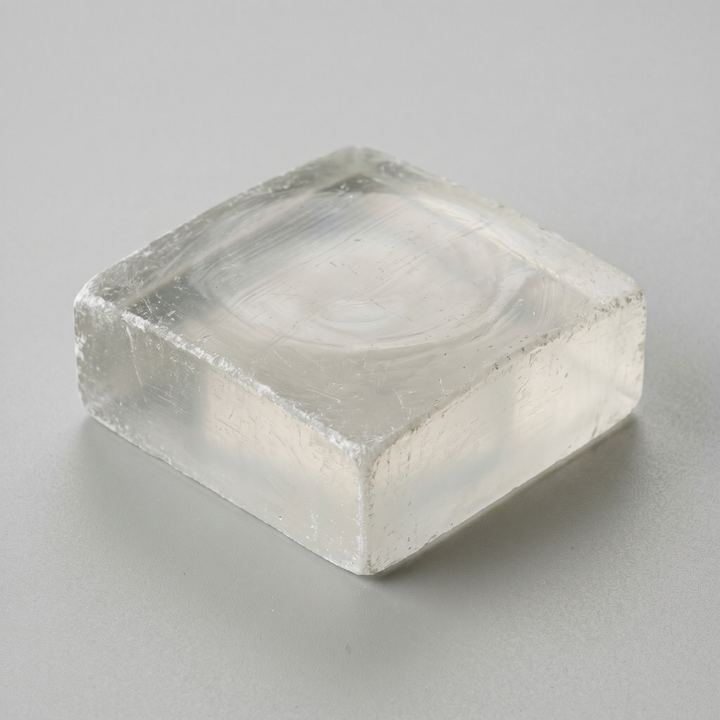
Clear, with a subtly warmer cast than ordinary float and noticeably more refractive bite at the cold-cut edge — the tin-potassium matrix throws a small but legible edge-glow that standard soda-lime stock does not. At 3.764 g/cm³ and 85×85×37 mm the slab is distinctly heavier than a soda-lime panel of equivalent footprint, a genuine two-hand lift, and the edge-tap carries a higher, longer ring than clear sheet glass. Surface reads pressed-glass matte with a shallow crown and one or two anneal striae near the long edges; edges cold-cut with the lapidary bloom that runs slightly coarser than float glass owing to the denser matrix.
Recipe
400 g batch · peak 1150 °C| element | precursor | formula | mass | safety |
|---|---|---|---|---|
| K | potassium carbonate / potash | K2CO3 | 24.69 g | safe |
| Si | quartz flour / silica | SiO2 | 21.47 g | safe |
| Sn | tin(IV) oxide | SnO2 | 53.85 g | safe |
- 1Ramp
- 2Hold
- 3Ramp
- 4Hold
- 5Ramp
- 6Hold