Nd₆O₁₂VY
rare earth oxide · rare earth ceramicNd6O12V1Y1 is a rare earth oxide suitable as rare earth ceramic. Color: grey-blue. Fired at 1200°C from 3 precursors (Nd2O3, Y2O3, V2O5). Workshop batch: 100g at €17.90. Compressive strength ~100 MPa; estimated 0.90 kg CO₂/kg (+309% vs clay brick). Notable: uv luminescent, visible absorber. Confidence: medium.
- forms at
- 1200 °C · high-fire
- replaces
- clay brick
- CO₂
- 309% higher than clay brick (0.90 vs 0.22 kg CO₂/kg; 4.1× higher)
- energy
- 100% higher than clay brick (6.00 vs 3.00 MJ/kg; 2.0× higher)
- compressive
- 100 MPa
- density
- 6.17 g/cm³
- crystal
- trigonal
- band gap
- 2.21 eV
- cost
- €179.00/kg · €17.90 / 100 g batch
- confidence
- medium (synthesis route)
- potential
- 0.37 · env 0.00 · novel 1.00 · struct 0.20 · lineage 0.50 · supply 0.10
- flags
- uv luminescent: Converts invisible ultraviolet into visible light. Signage panels, low-energy wayfinding tiles, emergency markings that draw their illumination from daylight rather than mains power. visible absorber: A real-colour solar-gain control layer. Where the body takes visible light into itself rather than reflecting it, the material becomes a selective heat collector — useful on thermal-mass walls, absorber panels, and warm-toned cladding.
Architectural potential
A neodymium-heavy rare-earth oxide with yttrium and vanadium as co-dopants, fired at 1200 °C to 100 MPa at 6.17 g/cm³, carrying both a UV-luminescent band and a visible-absorber band. The architectural argument is the pairing: the tile converts invisible ultraviolet into a visible emission at evening shift, while the visible-absorber band does slow solar-gain collection through the day. At three-times the embodied CO₂ of a fired clay brick the piece is not a volume material and belongs as small-area overlay. Natural placements are emergency-wayfinding tile patterns in stair cores whose illumination builds up through daylight and releases through the dark hours without mains wiring, accent cladding patches on warm-toned brick façades where the visible-absorber band supports a passive thermal wall behind, and signage tiles in archives and museum corridors where UV excitation can be engineered into the ambient light. Against the Gd7O12V1 sibling in this same batch the neodymium shifts the luminescent emission further into pink-violet, a register distinct from the warmer orange that gadolinium produces. The caveat is supply-chain fragility — neodymium-yttrium-vanadium triples score 0.14 — and a 100 g batch ceiling that keeps specification in the signature-patch register, never the envelope.
Material character
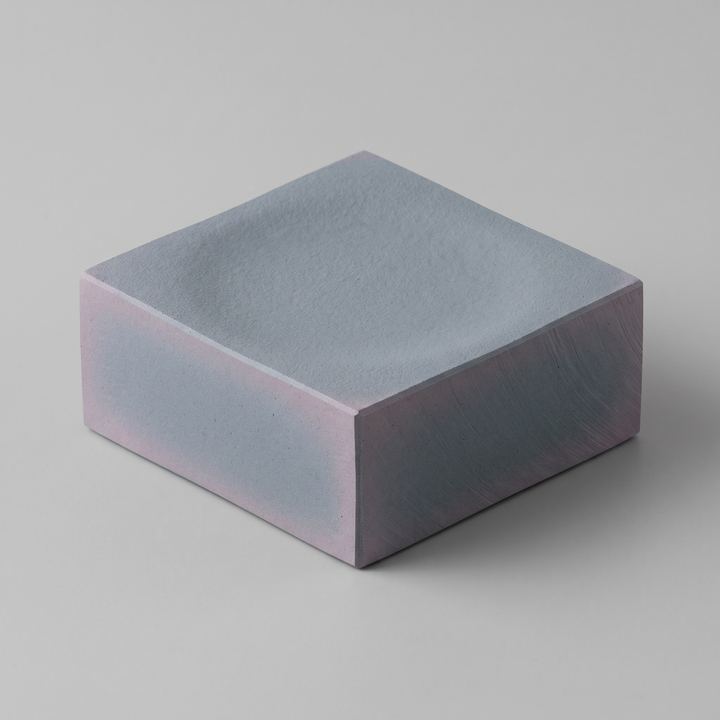
A cool grey-blue face — neodymium's characteristic lavender undercurrent muted by the yttrium-vanadium modifiers, distinguishable from the bluer gadolinium sibling by a clear violet shift under direct daylight and a warmer cast at shadow angles. At 6.17 g/cm³ and 70×70×33 mm the slab lifts two-handed, noticeably lighter in hand than the Gd7O12V1 tile of comparable footprint despite the same firing tier and nearly matched face dimensions. Skin is vitrified matte from the 1200 °C fire, with the shallow surface mottle typical of rare-earth silicates pooling during cooling. Edges cold-cut, kerf powder-pale. Fully opaque through its depth. Under 365 nm UV the face glows a soft pink — a documented emission distinct from the warmer orange of gadolinium.
Recipe
100 g batch · peak 1200 °C| element | precursor | formula | mass | safety |
|---|---|---|---|---|
| Nd | neodymium oxide | Nd2O3 | 83.2 g | moderate |
| V | vanadium pentoxide | V2O5 | 7.5 g | moderate |
| Y | yttrium oxide | Y2O3 | 9.31 g | moderate |
- 1Ramp
- 2Hold
- 3Ramp
- 4Ramp
- 5Hold
- 6Ramp
- 7Ramp
UV-luminescent — emits visible light under 365 nm UV
Visible absorber — saturated color from bandgap in the visible range