Li₈O₁₀TeW
heavy oxide ceramic · thermal mass ceramicLi8O10Te1W1 is a heavy oxide ceramic suitable as thermal mass ceramic. Color: neutral. Fired at 1250°C from 2 precursors (Li2CO3, WO3). Workshop batch: 200g at €45.30. Compressive strength ~100 MPa; estimated 0.94 kg CO₂/kg (+326% vs clay brick). Notable: electrochromic tungstate. Confidence: medium.
- forms at
- 1250 °C · high-fire
- replaces
- clay brick
- CO₂
- 326% higher than clay brick (0.94 vs 0.22 kg CO₂/kg; 4.3× higher)
- energy
- 108% higher than clay brick (6.25 vs 3.00 MJ/kg; 2.1× higher)
- compressive
- 100 MPa
- density
- 4.65 g/cm³
- crystal
- triclinic
- band gap
- 3.44 eV
- cost
- €226.50/kg · €45.30 / 200 g batch
- confidence
- medium (synthesis route)
- potential
- 0.35 · env 0.00 · novel 1.00 · struct 0.20 · lineage 0.50 · supply 0.00
- flags
- electrochromic tungstate: A voltage-switchable optical chemistry. In thin-film form a small DC signal shifts transmission from clear to tinted blue, opening the door to dimmable glazing and responsive partitions that do not need mechanical shading.
Architectural potential
A lithium-heavy tungstate-tellurate ceramic fired to 1250 °C, reaching only 100 MPa of compression — a distinctly lighter structural envelope than the potassium-zirconium sibling. At 4.65 g/cm³ the body is less dense too, so the thermal-mass argument weakens, but the electrochromic tungstate chemistry survives intact. The natural architectural place is non-load-bearing switchable-tint surface: hospital ward partition inserts where privacy switches on demand, reconfigurable library-carrel screens that tint during focussed work, and retail fitting-room wall panels that shift opacity without mechanical blinds. The lithium content pushes the optical response toward a cleaner clear-to-blue transition with less haze in the intermediate state, which matters where visible contrast between tinted and untinted regions is the architectural register. Supplements conventional glazing rather than replacing it. The caveat is stark: embodied CO₂ runs three hundred and twenty-six per cent above fired clay brick, the supply-chain score sits at zero, tellurium is a scarce by-product of copper refining, and €45.30 per 200 g batch puts any use into the bespoke-signage register. Lithium mobility at the tungstate surface also means the switching chemistry degrades over time; the specification has to budget for tile replacement on a ten-year cycle.
Material character
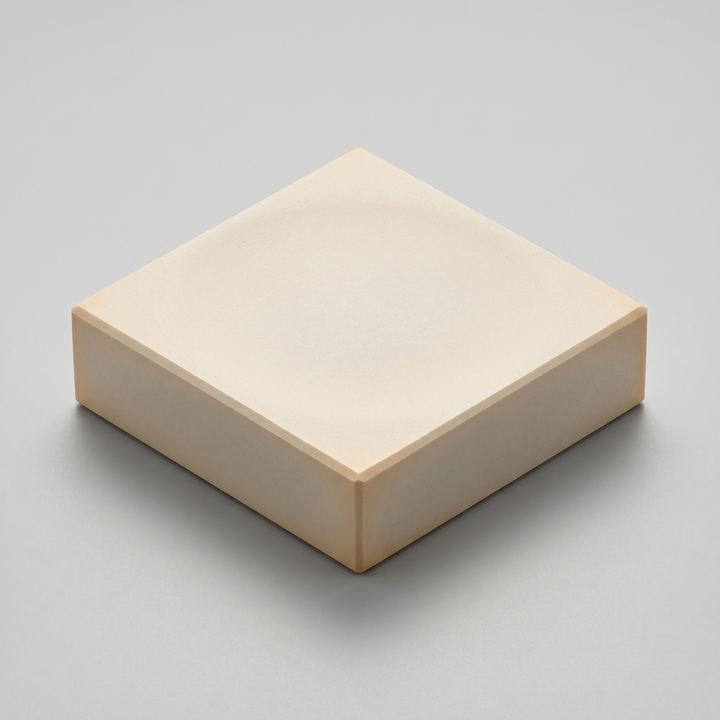
The slab reads a pale neutral white-grey, warmer than the zirconium-variant sibling thanks to the lithium-tellurate matrix softening the body. At 4.65 g/cm³ in an 85×85×30 mm format the piece is larger-footprint but actually lighter in the hand than the smaller K-W-Zr variant from the same family — the lithium substitution drops the density noticeably. Surface vitrified glossier than the potassium sibling, the tellurium lending a faint pearl-sheen that catches shadow under raking light; edges cold-cut, kerf-bright. Rings higher and longer than its denser sibling when tapped, the lithium content lightening the acoustic body. The tinted electrochromic state is invisible in the at-rest sample.
Recipe
200 g batch · peak 1250 °C| element | precursor | formula | mass | safety |
|---|---|---|---|---|
| Li | lithium carbonate | Li2CO3 | 56.04 g | safe |
| W | tungsten trioxide (yellow) | WO3 | 43.96 g | moderate |
- 1Ramp
- 2Hold
- 3Ramp
- 4Ramp
- 5Hold
- 6Ramp
- 7Ramp
Electrochromic — color switches under applied voltage (thin-film chemistry)