O₂PrSm₅Sn₆Zr₄
heavy oxide ceramic · thermal mass ceramicO2Pr1Sm5Sn6Zr4 is a heavy oxide ceramic suitable as thermal mass ceramic. Color: neutral. Fired at 1250°C from 4 precursors (SnO2, Sm2O3, ZrO2). Workshop batch: 200g at €47.30. Compressive strength ~300 MPa; estimated 0.94 kg CO₂/kg (+326% vs clay brick). Notable: uv luminescent. Confidence: medium.
- forms at
- 1250 °C · high-fire
- replaces
- clay brick
- CO₂
- 326% higher than clay brick (0.94 vs 0.22 kg CO₂/kg; 4.3× higher)
- energy
- 108% higher than clay brick (6.25 vs 3.00 MJ/kg; 2.1× higher)
- compressive
- 300 MPa
- density
- 7.86 g/cm³
- crystal
- orthorhombic
- band gap
- inf eV
- cost
- €236.50/kg · €47.30 / 200 g batch
- confidence
- medium (synthesis route)
- potential
- 0.30 · env 0.00 · novel 0.50 · struct 0.60 · lineage 0.50 · supply 0.10
- flags
- uv luminescent: Converts invisible ultraviolet into visible light. Signage panels, low-energy wayfinding tiles, emergency markings that draw their illumination from daylight rather than mains power.
Architectural potential
A heavy zirconate-stannate thermal battery with a UV-luminescent twist: samarium and praseodymium together emit in the visible range when excited at 365 nm, so the same slab that stores daytime heat also signals under targeted UV at night. Natural placements are south-facing thermal walls in atria and conservatories where the slow thermal day is the argument and the evening glow is a ritual accent; hypocaust-style floor slabs in gallery piers with integrated UV emitters under plinths; night-flush cooling cores in office-building thermal cavities that wayfind after dark without drawing on mains lighting. At 300 megapascals of compression the body can also act as a compressive wall element in this same register, not merely an infill. The caveat is double and heavy. Embodied CO₂ runs three and a quarter times higher than fired clay brick, and the cost of 47 euros per 200 g batch forbids bulk use entirely — this belongs as a signature trombe-wall insert, a ceremonial threshold plate, or a small-area accent, never as a full thermal mass volume. The samarium-praseodymium supply-chain score sits near 0.14, so specification has to be paid for by the dual capability, not by the heat storage alone.
Material character
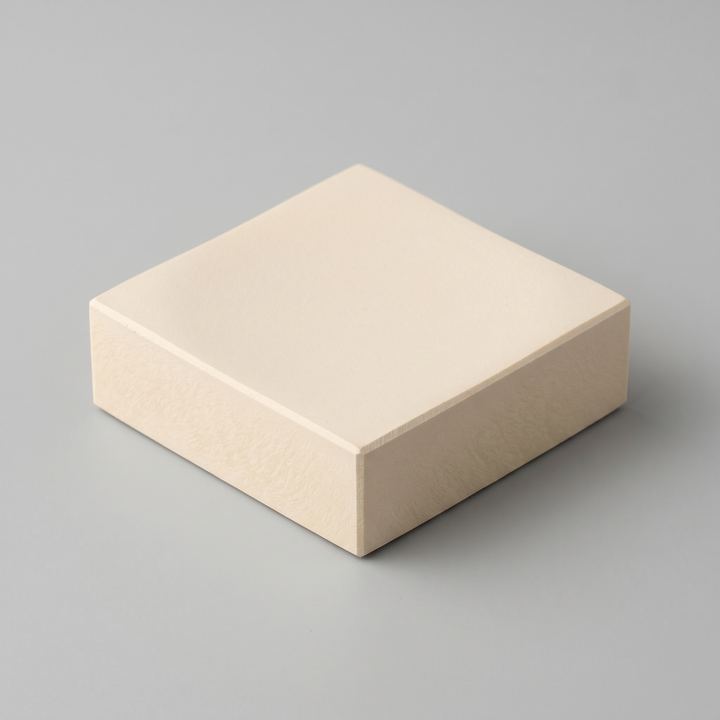
At 7.86 g/cm³ in a 70×70×26 mm slab the weight lands firmly two-handed — dense for its footprint, closer in hand-feel to a structural stone offcut than to a ceramic tile. The body reads neutral grey with a faint warm cream undertone from the samarium-praseodymium content, visible only in side-light; the post-UV emission belongs in a companion shot with 365 nm excitation. Skin vitrified matte from the 1250 °C fire, edges cold-cut with diamond-saw kerf-whitening. Fully opaque. Against a zirconate sibling without the rare-earth pair the colour is slightly warmer and the sinter finer-grained, reading more closely to a stoneware surface than to a technical ceramic.
Recipe
200 g batch · peak 1250 °C| element | precursor | formula | mass | safety |
|---|---|---|---|---|
| Pr | praseodymium oxide | Pr6O11 | 6.98 g | moderate |
| Sm | samarium oxide | Sm2O3 | 35.74 g | moderate |
| Sn | tin(IV) oxide | SnO2 | 37.07 g | safe |
| Zr | zirconium dioxide | ZrO2 | 20.21 g | safe |
- 1Ramp
- 2Hold
- 3Ramp
- 4Ramp
- 5Hold
- 6Ramp
- 7Ramp
UV-luminescent — emits visible light under 365 nm UV